WINDS
(Work in progress—when I am done I will announce it. I leave this content up, however, for there is still something to it.)
With the permission of the makers and players of the rest of the wind instruments, I'll be writing here mostly about the baroque oboe, and that is because the baroque oboe is the clearest example I can think of to visualize what happens with the waves produced by the Vibrating Corpus, the reed in this case, once they reach the pipe of a wind instrument. For brass players, the vibrating corpus is their own lips, and the beginning of the pipe is the mouthpiece itself.
First of all, of course, we are going to start looking at the reeds.
I wanted to see a reed in motion. To that end I made a hole in the bottom of a plastic bottle and introduced a bassoon reed through it. I sealed the hole around the bottom of the reed to avoid leaking and blew in the bottle. I saw the reed vibrating, and I saw that what actually vibrates in a reed is its very tip. The vibrating corpus of an oboe is, actually, the tip of the reed. The rest of the reed and the staple carry the mechanical waves produced by the vibration of the tip all the way down through the cane and the staple to the oboe, its wood, its very substance. The most common setting for oboe reeds in Europe today, uses two staples. In this setting mechanical waves must cross many boundaries before they reach the body of the instrument: from cane, to metal, to thread, to metal, to a whole bunch of thread, to wood. I leave for the traditional acousticians (Arthur H. Benade & Co.) the idea that the vibration of the reed sets in motion the air inside the instrument as the origin of its sound—because that theory says little about the shape and materials of an instrument, and we know how important shapes and materials are.
As I think of those waves traveling from the tip of the reed all along the cane until getting refracted into the staple, it becomes clear to me how important the density of the cane is, as well as the thickness of the blades, their form, and how smooth or rough their surfaces are. But not just the reed, but also the staple: what kind of metal it is made of, how long it is, how thick, its conicity. And even the thread, with its dampening effect: the more thread, the more dampening. Then, once those waves have reached the oboe, how the shapes in the oboe affect their propagation. But for now, I'll stay with the reed.
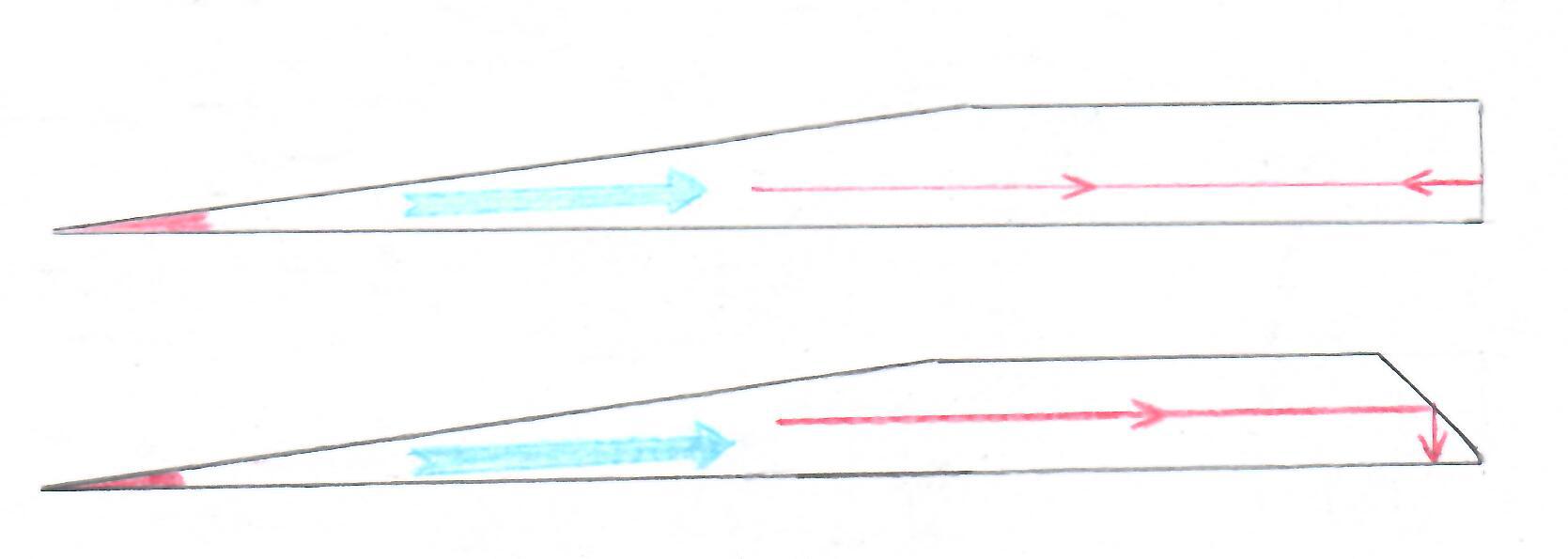
You might think that I'm talking nonsense if you always have thought about how reeds work following the theory of the traditional acoustics. To help you change your mind, I'll tell you about a little experiment of mine. In the next picture I've drawn an especial cut I made to some bassoon, clarinet and saxophone reeds. The bottom of the reed is usually cut in a straight angle to the blade. I turned that angle of 90 degrees into one of 45.

The result was always the same: the sound became much brighter, the articulation much clearer and the blow pressure needed was much less. And the matter is that according to the traditional acoustics, such a cut in such a place should have no effect at all in how the reed reacts or sounds. But it does have effects, and big ones. That is so because mechanical waves, coming down the reed from its tip, if its end is cut at 90 degrees will be mostly reflected back when encountering that surface, staying longer in the reed. Instead, when that surface is cut to 45 degrees most of the waves get directly refracted into the crook or bocal of the bassoon or the mouthpiece of the saxophone or clarinet.
Back to oboe reeds, it is said that we do not know how oboe reeds were before the 18th century. But Nora Post, an American oboe player (you can find her at www.norapost.com), wrote an article about the reeds for the oboe in the 17th century which was published as long ago as 1982 in The Galpin Society Journal:

"PLAYING CHARACTERISTICS OF THE DIDEROT AND OTHER SHORT-STAPLED REEDS
The playing qualities of these reeds are far superior to, and easily distinguished from, those of the long-stapled reed. Above all, the Diderot reed does not squeak, one of the most annoying problems associated with the long-stapled reed. Expressivity no longer need be tempered by the terror of squeak. The Diderot reed also has a wider dynamic range, and its disarmingly soft low register is particularly impressive. The tone quality is generally more robust, if sometimes less focused, than that of the long-stapled reed. The Diderot as well as other short-stapled reeds also solve another frustration encountered when one uses the long-stapled reed. I have often wondered why so many baroque oboes have an identical defect, i.e. an unreliable middle D, D# and E; in fact, there are original instruments on which these notes will not respond at all when played with this reed. It is inconceivable that instrument-makers throughout Europe all made exactly the same mistake, especially one of such magnitude. Far more likely the long-stapled reed is the culprit, a contention supported by the fact that the reeds I have described play these notes securely, with no risk of squeaks."
Nora Post, in "The 17th–Century Oboe Reed"
Unfortunately, in all my years playing in orchestras, I have never heard that particularly impressive and disarmingly soft low register because I have never seen anyone playing with a Diderot reed. But the more robust tone quality, if sometimes less focused than playing with other kinds of bridges, I have heard from my viola after it was set up with a Stradivari model of bridge.Though I would call it a much wider sound rather than less focused.
But why do I speak about my viola in this page about reeds? Because the Stradivari models of bridges and the Diderot reeds have something in common: they let waves reach the instrument by the shortest, most direct way, which conserves as much of their intensity as possible at their arrival to the body of the oboe (or the viola). Remember the five boundaries that waves must cross in the two-staples setting before they reach the body of the oboe? With the Diderot reed it is only two: cane, to a thin layer of thread, to wood. There could also be a 'to metal' boundary somewhere, but I've understood that that staple would be a small one inside the reed to just get it round, and that it is absolutely possible to make a Diderot reed with no staple at all.
